Showing posts with label succulents. Show all posts

Saturday, July 6, 2013

My Plants Survived My Absence. Here's Proof!


While I was off partying in the desert, my plants were busy too. All the indoor plants were relatively unchanged by the experience (though I did find a loving home for my leftover wandering Jews), so this update focuses on outdoor plants.
 
My purslane is growing like a weed, probably because it is a weed. As expected, it doesn't seem to mind the clay soil it's in. I've been sprinkling these leaves on sandwiches and in dips. They add a nice twist.


This plant is new! These are hens and chicks (probably Sempervivum tectorum). I got these (and a couple of "chicks" that fell out) for a dollar at a farmer's market. I couldn't pass them up.


My sage has some new growth, though it appears to be afflicted with some manner of fungus. I'm not sure what to do about this.


My basil and peppermint are affected too. My thyme is just beautiful, though, and the rosemary is also untouched and thriving. Maybe not as well as it thrives in Vegas.


My Swiss chard has never looked better. I've been eating these leaves on sandwiches too. It's a wonderful feeling to harvest homegrown food. There's nothing like it.


I've saved the biggest news for last. None of my tomatoes ripened while I was gone, but they've come a lot closer! And there are new fruits! When I play I Spy with this picture, I can spot eight tiny tomatoes. How many can you find?


This is the best picture I've gotten thus far of my ripening fruits. This picture shows three of them.


This shot is not so good, but it shows the most prolific cluster of fruits on the plant (so far).


In all, I am quite happy with how my plants are coming along. I just need to find some way to treat and prevent whatever kind of fungus or pest is going around. How are your plants doing this summer?

Next post: garden-fresh snacks.


Wednesday, May 22, 2013

Finally...

...I can keep plants outside. Today is my third day in my new apartment. Remember how I had half a salad's worth of Swiss chard before I left home? I have at least twice that today. One of my professors told our class that plants don't grow because of us--they grow in spite of us. The fact that the chard stayed alive for three months indoors and is now growing prolifically testifies to the truth in that statement.

So, here are the pictures of my plants' new homes. Maybe at the end of the summer I can do a before-and-after post. I'm sure there would be lots of improvement.

These are the three wandering jews that I've decided not to keep. I'm still looking for good homes for these little guys. They're really easy to care for. Thankfully they're recent cuttings, so they haven't developed much of a root system, so they can stay in this four pack for a while without becoming rootbound.


My spider plant and bromeliad aren't really near a window, but light from three windows reaches them, so they might be okay there.


My lucky bamboo also isn't in a window, but from what I understand, these plants actually benefit from staying out of direct sunlight. It works out very well.


This table contains the two succulents I brought, my wandering jew, and my purple shamrock. They've got some of the best seats in the house.


My jade plant (unfortunately not pictured) is near a window in the bedroom. The rest of my plants are outside. My tomato is looking happier by the day. The parsley pot (behind the tomato) was flooded by rain a couple of times, but I poured out the excess. We'll see how that does.


There's a noticeable difference between the Swiss chard in this shot and what it looks like now, a day later. I have high hopes for this crop.


My basil's still a bit raggedy, but I'm working on it. The peppermint, however, doesn't need any help.


I'm already excited to see my desert rose bloom, though the plant already looks very dramatic against this brick wall.


Here are the rest of the herbs. My thyme looks small, still, but if I can keep it out of heavy rains, it should be fine. I'm going to be cooking pizzas with rosemary soon, and I think I'm going to harvest a few leaves from my rosemary for it. Think of it: my first true harvest (eating doomed plant matter doesn't count) of the year. Miraculous.


What miracles are transpiring in your garden or containers?

Next post: more from the dawn of summer.

Monday, May 20, 2013

The Great Garden Planting of 2013: After

Yesterday we got Mom's garden plant, and I repotted nearly all of my plants. We accomplished a great deal, and I'm here to chronicle the seeds of our future success (somewhat literally!).

I'll start with my plants. I'm glad I repotted my spider plant; when I took it out of its pot, I could tell it was starting to get rootbound. There are lots of spider plants in the greenhouses that are so rootbound that they're pushing themselves out of their pots. I wouldn't ever want mine to get that desperate. It has lots of room to grow now.


Here's the wandering jew that I've decided to keep, as well as a succulent (the tag says it's Haworthia coarctata, but I highly doubt that because of the lack of "pearls") that I replanted. I'm taking two of these succulents.


My purple shamrock got the nicest pot. It's droopy from being out in the heat, but I think it will recover quickly.


Pictured here is the other succulent (of the same species) that I'm bringing home, as well as my jade plant. It seems like jade is a slow grower, so this pot should be suitable for a while.


Moving outside, here are my peppermint and thyme in their new homes. The peppermint might be able to take over a much larger pot, but I want to keep it manageable. I think I'm going to harvest pretty aggressively once it looks like its fitting the pot better.


The rosemary was also looking rootbound when I repotted it, so now it has deeper soil to probe into. Rosemary has a simple appearance, but I think it's a beautiful plant.


Now onto the grand finale: Mom's garden. This is what it looks like now. I think it's a perfectly sized plot for what Mom wants.


Here's the row of peppers and tomatoes, from the pepper side. No, the row isn't straight, but don't judge.


The same row, from the tomato side. I think Mom did a good job choosing her tomato plants. They're young and healthy, and I think they'll do great. She already got cages for them (and one for me, because she's sweet).


I had a lot of fun helping Mom transplant her vegetables and digging around in the soil. I'll make updates on the progress of the garden when I come home to visit.

Next post: tis' the season for my favorite flowers in the whole world.

Tuesday, April 30, 2013

Moonlight Garden

When I plan my future gardens, there are two objectives I keep in mind: form and function. I tend to favor function. There are tangible rewards for growing vegetables, fruits, edible flowers, and herbs. You can literally taste your success, which goes on to literally nourish your body, rather than just emitting an abstract sense of victory.

However, my eyes can be bigger than my stomach. I do have moments when I want a plant just for its looks. I love how my jade plant and spider plant look. I like five-color silverbeet in part for its five colors. So the wishlist moonlight garden I am about to describe is the culmination of those moments.

A moonlight garden is one in which plants with white or silver foliage or flowers are planted. The idea behind this is that the moon's rays reflect off the plants at night, leading to a glow-in-the-dark garden, perfect for evening parties or gatherings. I find this idea classy--all white flowers, lots of silvery leaves, all illuminating your guests as you entertain them in the dark of the night. It would be nice on quiet, lonesome nights too. A little surreal, maybe. At any rate, I want to try to create this kind of garden someday, and these are the plants I want to grow in it. As always with my plant lists, click on the hyperlinks to see a picture of the plant.

Iris germanica: Irises have always been some of my favorite flowers. Their elegant ruffles would fit in perfectly with the aesthetic of a moonlight garden. Which is to say, classic.

Hydrangea macrophylla 'White Ball': While most of my memories regarding hydrangeas come from my childhood vacations on Cape Cod, these beautiful bushes grow in my Midwestern hometown as well. Hydrangeas are fun as well as versatile. I don't know what pH level the soil needs to be for the flowers to be white rather than blue or pink, but the effect is worth it.

Convallaria magallis (Lily-of-the-valley): I was not familiar with these plants until this year. These are some of the sweetest flowers I've ever seen, and I would love to cultivate them someday.

Hellebore niger (White hellebore): Many of the plants on this list bloom a few feet off the ground. Irises grow atop tall inflorescences, and hydrangeas grow on sizeable bushes. Hellebores, however, grow close to the ground, so they would provide layering and depth to a moonlight garden. In addition, hellebores bloom in late winter and early spring, so they would provide white when most plants don't.

Salvia officinalis (Common sage): Writing about sage makes me happy since I already have a member of this species. My seedling's leaves are not yet pubescent, but someday they will be, and it's the pubescence (read: hair) that makes them silvery. The best part about using sage in a moonlight garden is that it provides form and function, as sage is a wonderful culinary herb.

Kalanchoe rhombopilosa: To switch things up a little bit, I'd like a white succulent in my moonlight garden. This Kalanchoe looks somewhat like an upright shelf fungus, and the entire plant (minus the flowers) is white and brown. This would, like the hellebores, give white color that's close to the ground. It would also provide a very different texture than most of the other plants.

Artemisia ludoviciana (Louisiana artemisia): This silvery bush has waist-high foliage, so the entire plant fits the "moonlight" ideal.

Senecio serpens (Blue chalksticks): Blue chalksticks are primarily ground cover, similar to the Kalanchoe. Some varieties look more blue or green than silver, but the silver ones are impressively so.

Cerastium 'Silver Carpet' (Snow in summer): This ground cover-y plant is, in one sense, the perfect plant for a moonlight garden. That's because snow in summer has both silver foliage and white flowers. Both are very pretty to boot!

Dichondra argentea 'Silver Falls' (Kidneyweed): As the cultivar name implies, kidneyweed is an ideal "spiller" plant for containers. It also makes excellent silver ground cover. A few pots of this have been growing at the greenhouse this spring, and it's a delight just to walk by them. They look even more silvery in person than in the photo.

Athyrium niponicum pictum (Japanese painted fern): I have a weak spot in my heart for ferns, and this one is no exception. Japanese painted ferns come in several colors, but most commonly seem to be silver with burgundy stems. This contrast would really liven up a moonlight garden and keep it from becoming a white-and-green monotony. Not to mention the fact that ferns like to bush out and take up some space.

Bonus: I'm going to go ahead and list Cylindropuntia echinocarpa (Silver cholla) with my moonlight garden selections. This cactus' spines are so incredibly white that a specimen would undoubtably go in this garden, should I end up living in a region that could support it. (And judging by the fact that I really want to live in the American southwest at some point, the inclusion of this plant seems likely.)

I realize that not all of these plants would grow in a single environment, so I will let my region dictate which I choose to grow. I would love to grow them all, though. You might notice I skipped over a couple of common choices for moonlight gardens. I have my reasons: lamb's ear is missing--this is because lamb's ear is incredibly invasive, and I prefer not to plant invasive species.

What combinations of these plants would you like to grow? Do you think a Japanese painted fern would look good next to irises? What about kidneyweed next to the Kalanchoe?

Next post: more views from around campus.

P.S. Thinking about it, Silver cholla would look really snazzy in a container with blue chalksticks and maybe some Senecio rowleyanus (string of pearls). The cholla would be the thriller, the chalksticks would fill in space, and the string of pearls would spill over. Perfect!

Saturday, March 30, 2013

Odds and Ends from the Neighborhood

While I was out walking around the town this week, I took some pictures of things that didn't fit into the categories of my other posts. So this is to be a miscellaneous hodge podge of things I found in my childhood home.

First was this bush. I don't know what kind of bush it is, or even if it really warrants the word "bush," but I found it attractive. I ordinarily don't care for purely ornamental plants, but this is an exception. It looks brighter in the pictures than it did in person.


And tucked (perhaps hidden?) behind this little bush was a succulent container! The collection of succulents was nice, but the plants didn't look so hot...

Was this forgotten or abandoned? I wish I had gotten to these darlings before winter did. I'd even take the rooster.
Another unfortunate thing I saw on my foray into the wilderness of town was a tree completely overtaken by English ivy, an aggressive invasive. The owners of this plant might be letting the vines grow for aesthetic reasons (I see no other way this could have happened), but the tree is not doing well, and the result is atrocious. Intentional or not, this is a sad sight for anyone who cares about plants.

A few of the leaves in this shot belong to that tree, but not many...
To end on a brighter note, I found a barn in town! I have no idea how I've missed seeing this structure my whole life, but apparently I have. I wonder what purpose this building serves.


That concludes the pictures from my travels here! Have you ever found something unexpected in familiar places? Do you sigh when you see horribly mistreated plants? Do you have any idea what that evergreen bush was?

Next post: news about my summer crops.

Sunday, March 24, 2013

The Plants I Miss Most of the Time

I am home for a week! It's great to have a minimal number of tasks to accomplish, free laundry, and home-cooked food. But, of course, I take special pleasure in seeing some of my plants that I can't keep at school. I'll be showing them off shortly.

First, though, all my plants made it home safely. Note how bright it is in this room!


This next plant is my desert rose. It's not in bloom, and it doesn't have a lot of leaves, but the leaves it has look healthy.


Next to my desert rose is a lily plant that's a family heirloom. It has great magenta-lavender blooms, just not at the moment.


This spindly guy is Basil, my basil plant. He's not branching out very much. Do you know any remedies for this odd growth pattern? Other than that, though, he seems to be doing great.


Next to Basil is this succulent, which is a Haworthia coarctata. I've had this plant (there are multiple plants now) for several years, but it needs to be in a shorter pot.


Perhaps a shallower pot and sandier soil will prevent this from happening.


Those are all the plants living here that are mine, though I might end up with one of my mother's vining/creeping houseplants. They're nice and very easy to care for, but they grow all over your stuff. Maybe I'll showcase these plants in another post. For now, though, you can expect...

Next post: Greenhouse Pictures: The Final Chapter.

Sunday, March 17, 2013

Spiders and Seedlings and Jade, Oh My!

There have been so many recent developments that I don't even know where to start. I'll arbitrarily follow the order of the pictures I took.

My spinach seedlings are starting to develop their first true leaves! Notice the difference in shape between them and the seed leaves. It's quite the contrast, and it will only become more different as time goes by.


My other spinach plant is trying to do the same thing this one has. It may just need more time. However, it seems kind of limp, and I'm wondering if the stem didn't get injured when I transplanted it. Time will tell.


The next order of business is my zucchini plant. It's still miniscule, but I believe it's trying to flower. I don't know if zucchinis can flower multiple times throughout a season, but if mine goes through with it, its new caretakers are going to have some microscopic fruits. They produce pretty flowers, though.


Now for some really exciting news: my thyme has sprouted! Well, some of the plants have. I may have to thin the ranks at some point because thyme seeds are tiny, so I have no idea how many I planted. But for now, I'm just happy that the seeds germinated! I don't think I've ever grown a plant from seed before, so this is an important accomplishment for me.


As you'll notice, it's extremely difficult to get my camera to focus on something as small as these seedlings, so they are blurry. The green dots are the seed leaves. You can see some of the stems.


Fun fact: when I was little, I thought the lyrics to the Steely Dan song "Reelin' in the Years" were "Are you reelin' in the yeast?/Stowin' away the thyme?/Are you gatherin' up the teas?/Have you had enough of mine?" Yes, I was destined to be a foodie even then.


My chard is still looking like this, though.

Nada.
The biggest news from this front is my two new houseplants that I propagated in class. This one is a spider plant. Spider plants are very efficient at filtering air, and they're pleasant in general. Spider plants are thus named because they reproduce by sending out stalks that have another spider plant-shaped plant on the end of them. They look like little spiders.


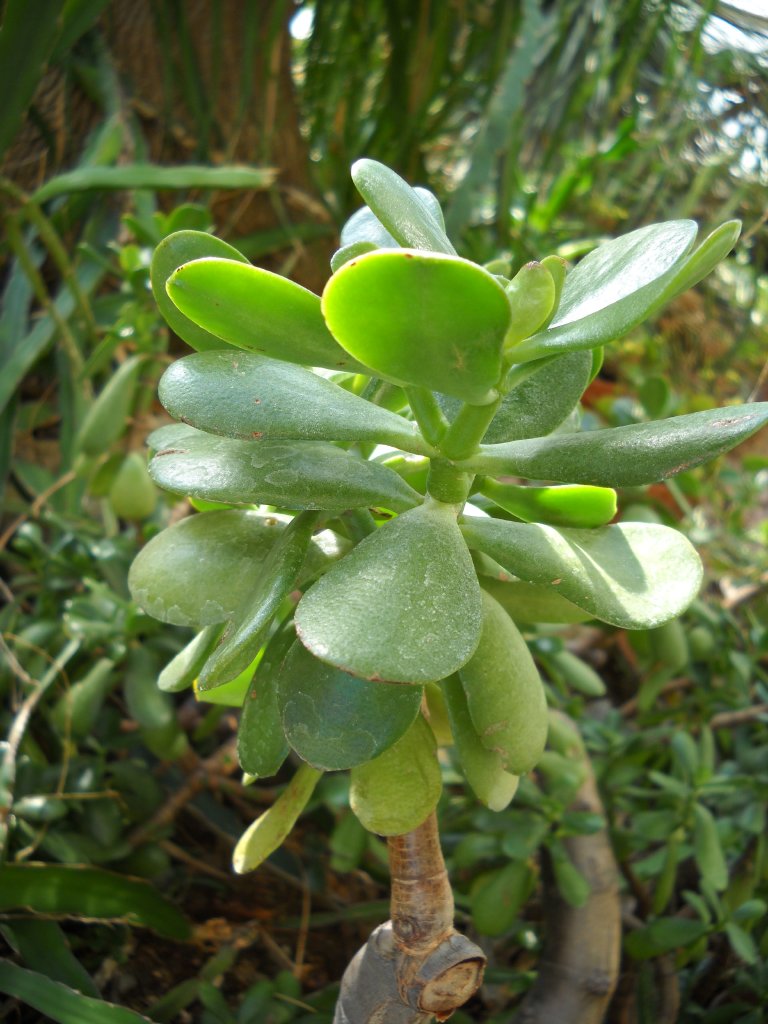
My second houseplant is a jade tree, acquired in the same manner as the spider plant. Jade plants are succulent, but they form woody stems eventually. I find them aesthetically pleasing (and mine's putting on new leaves)!


Here's an aerial view.


So this is the new and improved windowsill shot:


Perhaps the chard will soon join this happening array of friends. But until then...

Next post: flowers in my hometown!

Thursday, March 14, 2013

University Greenhouse, Part V: Tropical Nirvana

Today we're transitioning from the arid desert to a tropical oasis (literally, as the greenhouse has a room that's just a koi pond surrounded by aquatic and tropical plants). Enjoy your stay!

First up for today is part of a jade tree. This was still in the desert room. I planted a cutting of jade in one of my classes and might be bringing it home this week. They're beautiful, in my opinion. This one has some hard water stains on it but is still looking healthy.


I don't know what this white vine is, but it's neat! Also of note is the fact that I recently learned how white plants like this photosynthesize. Green plants have chlorophyll, which is the pigment that captures the sun's energy, but other pigments can do this as well. Carotenes are pigments that photosynthesize sugars for orange and some yellow plants, and xanthophylls do the same for some yellow and white (or "clear") plants. Anthocyanins are the pigments responsible for making plant tissues red or purple, but these are incapable of converting electromagnetic radiation into carbohydrates. So this plant must make its food via xanthophylls. There's your nerdy plant lesson for the day!


Now we've made it to the koi room. Yes there are real, live koi fish in it. You can see the pond in the background. This leaf is impressive.


This is why it's impressive.

That is a women's size 9 shoe. That leaf probably has more area than ten soles of that shoe. Eve could have stitched two together and been completely modest.
These leaves were similarly large and impressive, but even more interesting. I don't know how they develop those holes. Also, when taking this shot I was ripped from my immersion in the splendor by that SUV. You don't think about it while wandering about this magical plant playland, but there's a parking lot and a whole concrete world right outside.


This leaf too was intriguing. I wish more plants were labeled, but I think the person staffing this greenhouse has been tasked with identifying its residents. So they're working on it. Maybe I'll go back there in a few months and find more names to match all the beautiful faces (more like fronds).


Speaking of fronds, here's a fern! While ferns can survive and thrive in lots of different conditions (they're great houseplants, as they filter air superbly), they can only reproduce in continually moist environments. In tomorrow's post you'll get to see fern reproduction in action, and I'll rant geekily about why that only happens when there's lots of water around.


With this picture, we move into the last room of the greenhouse. This room is also kept at tropical temperature and humidity levels. It is home to two famous (infamous? nefarious? you decide) plants. This is the first: a member of the Orchidaceae (orchid) family that produces a long, slender bean pod containing vanilla beans. These are used to produce vanilla extract and those devilish iced frappucinos you can get at Starbucks. One vanilla bean pod sells for ten bucks in grocery stores, making me wonder who takes home the pods produced by this plant. It wasn't bearing fruit on this visit, but it was last fall.


There were a lot of orchids in this room, but only one was blooming. Their blooms just look fancy, so I can see why so many people enjoy cultivating them. Last time I went to this greenhouse, nearly all the orchids were in bloom. The smell was so intoxicating it almost knocked me over.


Also in this room were several bromeliads. This first one was larger and crazier than mine, and it's "rooted" in the tree behind it. Bromeliads are basically the only plants that don't need soil to live. I think those yellow stalks to the left are probably flowers by now.


Here are some tamer bromeliads that look a lot more like tillandsia, which is what I have. These were on the same bench as most of the orchids, which makes sense: you're supposed to fertilize bromeliads by mixing orchid fertilizer with water.


At this point, you may be asking yourself something along the lines of "Wait, she said there were TWO famous plants in this room, but she only talked about one!" This is true. The next celebrity plant is coming to you tomorrow, but in case you can't handle that much suspense, I'll give you a hint: its scientific name is Theobroma cacao And if you can't figure it out, you only have to wait until tomorrow.

Next post: Greenhouse Pictures: Tropical Oasis: Part II, featuring my special mystery guest Theobroma.