Saturday, March 23, 2013

In Which I Attempt to Appreciate Winter

After spending far too many months in skin-bitingly, ear-achingly, breath-seeingly winter, we're done with it. At one point this winter, my car was trapped on ice for two weeks. At a couple of points, my pant legs froze solid as I was walking home from work. At several points, I slipped on ice.

But there are good things about winter too, right? I mean, there couldn't be spring without winter. Many plants cannot thrive unless their dormant bodies are chilled to a certain point in winter (this is called vernalization). So winter's pretty important. Plus there's snow cream (bowl of fresh snow + splash of milk + 1 Tbsp sugar or sweetener + a few drops vanilla = wintry heaven).

And there's always...well, that's about as far as I've ever gotten. Until now. Walking around campus this winter, I've noticed one other benefit of the cold, dark season: visibility. Without leaves on the trees, you can see things like ornate roof designs (see the Loebner magnolia pictures in Campus Smells Spring's Approach) and birds' nests. That's my focus for today because I've found a lot of them.

This tree is near the older buildings on campus. I spied five birds' nests in this one tree. I've never seen so many nests in one tree before!


Looking back at these pictures, I can't see where the fifth nest is, but I know I've seen five. As a plant person, I appreciate birds for their beauty and their tendency to eat and disperse seeds.


The rest of these trees are on my way to work, near a fairly large street. The birds around here are so brave, they wouldn't mind building their homes next to highways. In this first example, notice how the nest is not supported by a fork in the branch. It's just balancing on one branch. I wouldn't want to live on such a precarious perch, but obviously the birds manage.
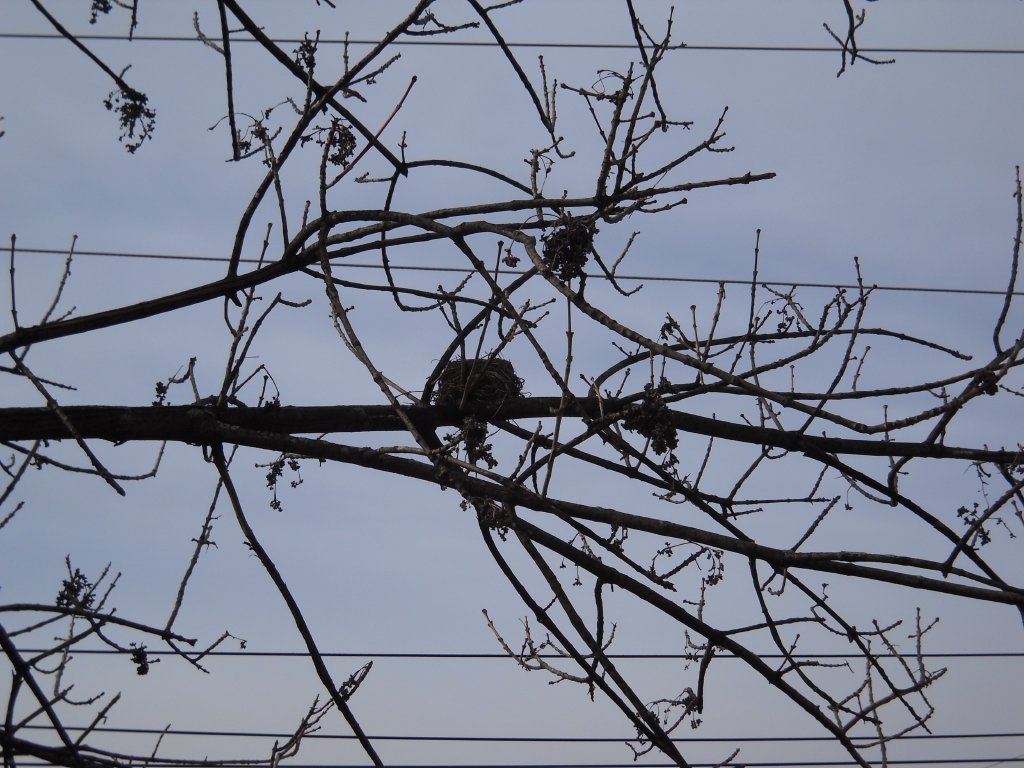

The best thing about birds' nests is that you can watch the bird family as it grows over the years. This isn't really possible if the nests are in trees covered in foliage, but the empty nests are still nice to see. I have no idea how birds build these suckers. One doesn't think of birds as being particularly dextrous or creative. This nest, at least, seems more stable.


I also don't understand how birds can navigate the thick foliage around their homes or remember exactly where their nests are. That's especially true for the birds living in the tree with five nests.


This was the only nest I managed to capture with a bird around it. The bird is the smooth, round shape just above the nest.


And after I took that shot, she flew off!


So apart from snow cream and preparing plants for spring, birds' nests are about all winter is good for. Are there any other advantages you can think of? Do you enjoy birdwatching when you're out in nature (or in the middle of small cities)?

Thanks for reading.

Next post: the plants that live at my house.

Friday, March 22, 2013

More Chard!

For a number of days, I was wondering if I was only going to have the two swiss chard plants appear. Boy, was I wrong. I had three more spring up in one day! Maybe they're coming in waves, and I'll see a few more pop out over the weekend. I took pictures over the course of a couple of days, so you can see how rapidly they are growing. Nothing I grow seems to grow as quickly as all the plants at the greenhouse, but then again, they use liquid fertilizer daily. I use a slow-release fertilizer. Maybe I should get on that...

Two of the newbies seem to have emerged from the same seed. Here they are when I first saw them, on Tuesday.


And this is what they looked like the next day. Pretty big difference, huh? Right now they're as tall as the first two are below.


This next seedling is the newest of the bunch. It's all by itself. I know you can barely see it in this picture; that small banana-looking object is its pair of cotyledons.


This picture is better, since the little tyke was standing up straighter on Wednesday.


These pictures are an update of what the first two seedlings are up to. If you were wondering, they're busy growing taller all the time. This was taken Tuesday...


...And this was taken Wednesday! Their little leaves look so happy. As you can see, all of my chard appears to have fuschia stems except for one that's whitish or yellowish. That's fine with me. I can deal with hot-pink vegetables this summer.


A couple of other bits of news: my zucchini is saying goodbye tomorrow and going to its new home. I'll miss it, but hopefully it can be outside and flourish in its new environment.

Also, I'm leaving for spring break, so I have to pack up all my plants. Normally, transporting plants is a stressful experience for the transporter and the plants, but I'm looking on the bright side: Scott lent me some boxes so I don't get dirt all over my car, and my house has a southern exposure. This means my plants are basically getting the equivalent of a tropical vacation.

While I'm home, I'll introduce Basil, my basil plant, to the blog. Basil is staying at my house for its better light, but I'm getting it back come summer. Which is exciting.

Next post: Winter in Retrospect.

Thursday, March 21, 2013

Campus Smells Spring's Approach

As the weather slowly improves, lots of plants on campus are beginning to realize that spring is upon us. In fact, I saw my first daffodil bloom on campus today (alas, I was caught without my camera). However, I have been fortunate enough to capture a few plants in bloom throughout my walks around the school.

First: Helleborus purpurescens. These hellebores, or Lenten roses, are as sweet as can be. I always personify them as being shy because their blooms face the ground, as though they're bashful. I imagine I'm not the first to make that connection, though.


There were also purple ones! I enjoy the color on these.


This was the most photogenic little group of all of them. Unfortunately, the wind was blowing really hard, so the foremost bloom is out of focus. I guess that makes this a more interesting shot, though, since your eye is drawn to an unexpected flower.


The next plant that stuck out to me was Magnolia x loebneri, or a Loebner magnolia. I'm sure this tree will be white with blooms in a few days, but I liked seeing it just poking out a few cautious buds.


Red brick on blue sky always look good together, and it provides a lively backdrop for this tender moment in this tree's life.


In yoga the other day we were supposed to think of something for which we were thankful, like loved ones, the sunny day, or taking time for ourselves by coming to the class. While I was thankful for all of those things, I thought that I was thankful for the magnolias and the hellebores.


This shot's background is slightly less distracting, though.


This next tree was what prompted me to start taking pictures in the first place. Monday morning was a gray one, and as I was walking to class, the neon yellow of the buds on this tree were eye-catching, to say the least. I couldn't tear my eyes away. Sadly, I didn't have time to photograph it in that lighting, but even in the middle of the afternoon you can see it's ready for the warm season. Let's approach it, shall we?


 Closer...


Closer...


Okay, this is close enough! I think you get the point. This fine tree is a Cornelian cherry dogwood, or Cornus mas, according to the signage below it. As you can see, these flowers are almost as bright as street signs!


I gave the dogwood a little more space here. Yellow and blue is one of my favorite color combinations. Even if it wasn't before, this tree has convinced me.


That's about all I've got as far as springy foliage and flowers go. However...

Next post: Chard-related news.

Tuesday, March 19, 2013

Little Post, Big News

Yeah, yeah, I know. I said I'd post greenhouse pictures today. And I'm not. Again. But I have marvelous news! However, I may have lied in the title: the news is actually very small. Why am I lying so much on this blog?


My first two seedlings of five-color silverbeet (AKA Swiss chard 'Bright Lights' or 'Rainbow') have sprouted! See those exotic stem colors? Those will become even brighter as the plants grow. Each seedling is around an inch tall right now.


I first saw these Sunday night. They were about half an inch tall then. What's remarkable is that they must have popped up within a two-hour timespan, because they weren't there yesterday evening. Then I watched a movie, and when I came back, ta da! They had made their appearance. Still no sign of any other seedlings (though I'm proud just to have two).

I just checked my basket for new arrivals, and there haven't been any, but these two are actually taller now, and their leaves are bigger. So exciting. I'm growing food in a dorm room!

Next post: spring shows its face on campus.

Monday, March 18, 2013

The Flowers of Spring

Because the forecast is calling for light snow today, I'm going to cheer everyone up with some pictures (and a video) of some springy flowers that I photographed with a friend last weekend. My neighbors at home have daffodils that bloom at least three weeks before anyone else's do. It never fails, and they comprise the sweetest sight you can imagine when everything else in the neighborhood is dark and bleary.

To paraphrase a great poet: a pop of color is a pop of color, no matter how small.


For comparison, these are the daffodils in my yard.


Not quite there yet.
These are some better shots of the flowers. Unlike most plants with showy blooms, you can't go wrong with having a lot of daffodils. As my mother put it, they aren't ostentatious.


This photo is property of Breanna Akins.
We also found this on our journey to capture the daffodils. I've not seen foliage like that before.


When I was home, I unknowingly took a picture of two crocus plants. My friend Bre later supplied me with more pictures of them, so now you can witness their development over the course of a week.

Week 1:


Week 2:

Photo courtesy of Breanna Akins.
And here's what those two will look like in another couple of weeks.

Again, courtesy of Breanna Akins.
What flowers are springing up in your neck of the woods? Do you agree that one can't have too many daffodils?

Next post: more greenhouse adventures.

Sunday, March 17, 2013

Spiders and Seedlings and Jade, Oh My!

There have been so many recent developments that I don't even know where to start. I'll arbitrarily follow the order of the pictures I took.

My spinach seedlings are starting to develop their first true leaves! Notice the difference in shape between them and the seed leaves. It's quite the contrast, and it will only become more different as time goes by.


My other spinach plant is trying to do the same thing this one has. It may just need more time. However, it seems kind of limp, and I'm wondering if the stem didn't get injured when I transplanted it. Time will tell.


The next order of business is my zucchini plant. It's still miniscule, but I believe it's trying to flower. I don't know if zucchinis can flower multiple times throughout a season, but if mine goes through with it, its new caretakers are going to have some microscopic fruits. They produce pretty flowers, though.


Now for some really exciting news: my thyme has sprouted! Well, some of the plants have. I may have to thin the ranks at some point because thyme seeds are tiny, so I have no idea how many I planted. But for now, I'm just happy that the seeds germinated! I don't think I've ever grown a plant from seed before, so this is an important accomplishment for me.


As you'll notice, it's extremely difficult to get my camera to focus on something as small as these seedlings, so they are blurry. The green dots are the seed leaves. You can see some of the stems.


Fun fact: when I was little, I thought the lyrics to the Steely Dan song "Reelin' in the Years" were "Are you reelin' in the yeast?/Stowin' away the thyme?/Are you gatherin' up the teas?/Have you had enough of mine?" Yes, I was destined to be a foodie even then.


My chard is still looking like this, though.

Nada.
The biggest news from this front is my two new houseplants that I propagated in class. This one is a spider plant. Spider plants are very efficient at filtering air, and they're pleasant in general. Spider plants are thus named because they reproduce by sending out stalks that have another spider plant-shaped plant on the end of them. They look like little spiders.


My second houseplant is a jade tree, acquired in the same manner as the spider plant. Jade plants are succulent, but they form woody stems eventually. I find them aesthetically pleasing (and mine's putting on new leaves)!


Here's an aerial view.


So this is the new and improved windowsill shot:


Perhaps the chard will soon join this happening array of friends. But until then...

Next post: flowers in my hometown!